What is Pi? The Circle Constant Explained
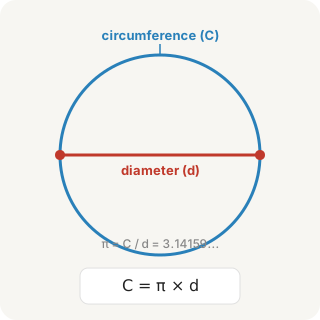
Pi (π) is the ratio of a circle's circumference to its diameter. No matter the size of the circle, this ratio is always the same: 3.14159265358979...
Why is it always the same?
If you measure the circumference of any circle and divide it by the diameter, you always get pi. A bicycle wheel, a planet, a coin: the ratio never changes. This is a consequence of the geometry of flat space.
Pi never ends
Pi is irrational, meaning it cannot be written as a fraction of two whole numbers. Its decimal expansion continues forever without repeating. Mathematicians have computed over 100 trillion digits. No pattern has ever been found.
Where pi appears
- Euler's identity: e^(iπ) + 1 = 0
- Normal distribution: the bell curve contains √(2π)
- Fourier transforms: used in audio processing and MRI machines
- Wave equations: describing light, sound, and quantum probability
Key facts
| Fact | Value |
|---|---|
| First 10 digits | 3.1415926535 |
| Proven irrational | 1761 (Lambert) |
| Proven transcendental | 1882 (Lindemann) |
| Current record | 105 trillion digits (2024) |
| Pi Day | March 14 (3/14) |
How to memorise pi on MemorisePi
MemorisePi groups pi into blocks of 6 digits, each mapped to a finger path on a numpad. After a few sessions, your fingers know where to go before your conscious mind catches up.
Practice with flashcards
Reinforce what you just read with interactive cards. Track your progress session to session.
Study flashcards Play numpad trainer