What is Euler's Number e? Natural Growth Explained
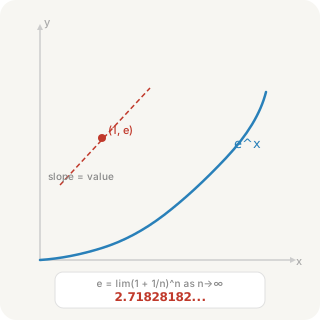
Euler's number e is approximately 2.71828182845.... It is the base of the natural logarithm and appears wherever continuous growth or decay occurs.
The unique property
The function e^x is the only function that is its own derivative. Its slope at every point equals its value. This makes e the natural base for calculus.
Where e comes from
Imagine a bank account earning 100% interest per year. Compounded more and more frequently, the result converges to e. Formally: e = lim(n→∞) (1 + 1/n)^n
Where e appears
- Compound interest: continuous growth at rate r gives e^(rt)
- Radioactive decay: half-life formulas use e
- Normal distribution: the bell curve is e^(-x²/2) / √(2π)
- Euler's identity: e^(iπ) = -1
Key facts
| Fact | Value |
|---|---|
| Decimal value | 2.71828182845... |
| Discovered | Jacob Bernoulli, 1683 |
| Named by | Leonhard Euler, 1731 |
| ln(e) | 1 |
| e is irrational | Proved 1737 |
Practice with flashcards
Reinforce what you just read with interactive cards. Track your progress session to session.
Study flashcards Play numpad trainer